

In today’s freight market, few cost drivers are as volatile, or as misunderstood, as fuel. With crude oil prices surging and diesel following closely behind, understanding how fuel surcharges (FSCs) work is no longer optional. It’s essential to managing your transportation spend.
What Is a Fuel Surcharge?
A fuel surcharge is an additional charge applied to a freight rate to account for fluctuations in diesel fuel prices. Instead of constantly renegotiating base rates, carriers use FSCs to adjust pricing dynamically as fuel costs rise and fall.
At its core, the concept is simple:
- Base rate (linehaul) = fixed cost of transportation
- Fuel surcharge = variable cost tied to diesel prices
This structure allows both shippers and carriers to maintain stability while still accounting for real-world fuel cost changes.
The Role of the EIA Diesel Price
In the U.S., most fuel surcharge programs are tied to the weekly on-highway diesel price published by the U.S. Energy Information Administration (EIA).
Here’s how that works:
- The EIA publishes a national average diesel price every week
- Carriers use that number as a benchmark
- FSC tables or formulas adjust based on that weekly price
While the EIA does not set or regulate fuel surcharges, its data is widely used across the industry as the standard reference point. Carriers typically set their Fuel Surcharge program based on the region that they operate within. A national carrier would utilize the National Average however a carrier in the New Jersey and Pennsylvania might utilize a more regional average, such as PADD1B.

How Fuel Surcharges Are Calculated
There is no single formula, but most programs follow a similar structure:
- Baseline Fuel Price
A starting point (e.g., $1.50/gallon).
Fuel below this level is “included” in the base rate. - Current Diesel Price (EIA)
The weekly published price. - Trigger Mechanism
When diesel rises above the baseline, the surcharge activates. - Calculation Method
Two common approaches:
• Per-mile surcharge (common in truckload)
• Percentage of linehaul (common in LTL)
If diesel increases, the surcharge increases proportionally. If diesel drops, the surcharge decreases.
Think of it as a thermostat for fuel costs—constantly adjusting to maintain balance.
How Fuel Surcharges Are Calculated
At a practical level, fuel surcharges come down to a simple formula:
FSC per mile = (Current Diesel Price – Base Fuel Price) ÷ Miles Per Gallon (MPG)
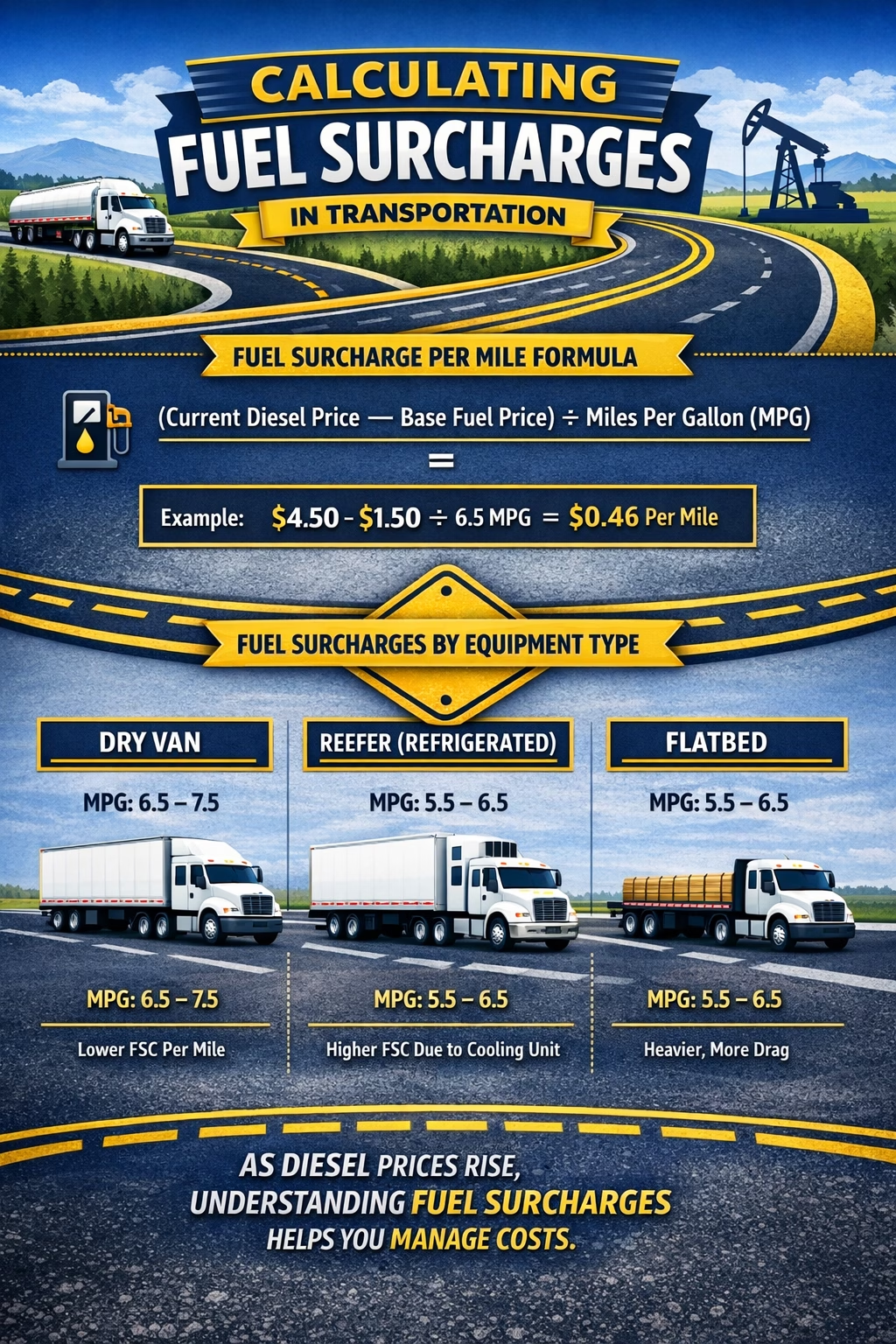
Example:
- Current diesel price: $4.50/gallon
- Base fuel price: $1.50/gallon
- MPG: 6.5
FSC = ($4.50 – $1.50) ÷ 6.5 = $3.00 ÷ 6.5 = $0.46 per mile
Fuel Surcharge by Equipment Type
Different equipment types consume fuel at different rates, which directly impacts the fuel surcharge.
Dry Van
- Typical MPG: 6.5 – 7.5
- More aerodynamic, lighter loads
- Lower FSC per mile
Dry Van Truckload FSC Example:
($4.50 – $1.50) ÷ 7.0 = $0.43/mile
Refrigerated (Reefer)
• Typical MPG: 5.5 – 6.5
• Additional fuel used for refrigeration unit
• Higher FSC due to engine + unit fuel consumption
Refrigerated Truckload FSC Example:
($4.50 – $1.50) ÷ 6.0 = $0.50/mile
Flatbed
• Typical MPG: 5.5 – 6.5
• Heavier loads, more wind resistance
• Similar or slightly higher FSC than dry van
Flatbed FSC Example:
($4.50 – $1.50) ÷ 6.0 = $0.50/mile
Why Fuel Surcharges Exist
Fuel is the largest variable cost in trucking, often representing 30–40% of total operating expenses.
Without a surcharge mechanism:
- Carriers would need to constantly reprice freight
- Contracts would become unstable
- Capacity would tighten during fuel spikes
Fuel surcharges solve this by:
- Protecting carrier margins
- Creating transparency for shippers
- Allowing contracts to remain intact during volatility
Why This Matters Right Now
1 – Crude Oil Is Driving Rapid Cost Increases
When crude oil prices rise, diesel prices typically follow quickly.
Recent geopolitical disruptions and supply constraints have pushed oil prices significantly higher, creating immediate pressure on transportation costs.
2 – Fuel Surcharges Adjust Fast
Unlike base rates, FSCs often update weekly based on EIA data.
That means:
- Your transportation costs can change week to week
- Budgeting becomes more complex
- Spot and contract rates can diverge quickly
3 – Volatility Is the New Normal
Fuel is no longer a predictable expense—it’s a high-frequency variable.
As industry trends show, even small diesel increases can quickly ripple through freight rates and overall supply chain costs.
What Shippers Need to Understand
1 – Not All Fuel Surcharges Are the Same
There is no standard Fuel Surcharge program. Every carrier has:
- Different baselines
- Different MPG assumptions
- Different calculation methods
Understanding these differences is critical when comparing rates. For shippers, comparing fuel surcharges can be a painstaking task. If you’re a shipper managing only a few carriers, it’s easy to work off the carrier’s fuel surcharge, but if you’re working with 100+ transportation providers, it’s best to have those providers utilize your fuel surcharge. This will ensure all carrier look at things evenly and allow you to do an “apples to apples” comparison.
2 – Fuel Strategy = Competitive Advantage
Companies that actively manage fuel exposure:
- Forecast better
- Budget more accurately
- Make smarter routing and mode decisions
Utilizing a Fuel Surcharge program allows you to remove variable costs from the conversations with carriers which can lead to more productive discussions surrounding operating costs and the impacts of shifting volumes.
The Big Takeaway
Fuel surcharges are not just a line item, they are a core mechanism that keeps the freight market functioning.
In a stable market, they’re background noise, most times considered an accessorial charge.
In today’s market, they’re front and center and considered a primary cost driver.
Understanding how these fuel surcharges work gives you:
- Better cost visibility
- Stronger negotiating leverage
- More control over your supply chain
As crude oil prices continue to surge, the companies that understand the impact of fuel surcharges will be the ones that manage costs, protect relationships, and see fewer disruptions in their supply chain.